What are the requirements for the rescue of persons working in a confined space?
The Confined Space Regulations 1997 states that:
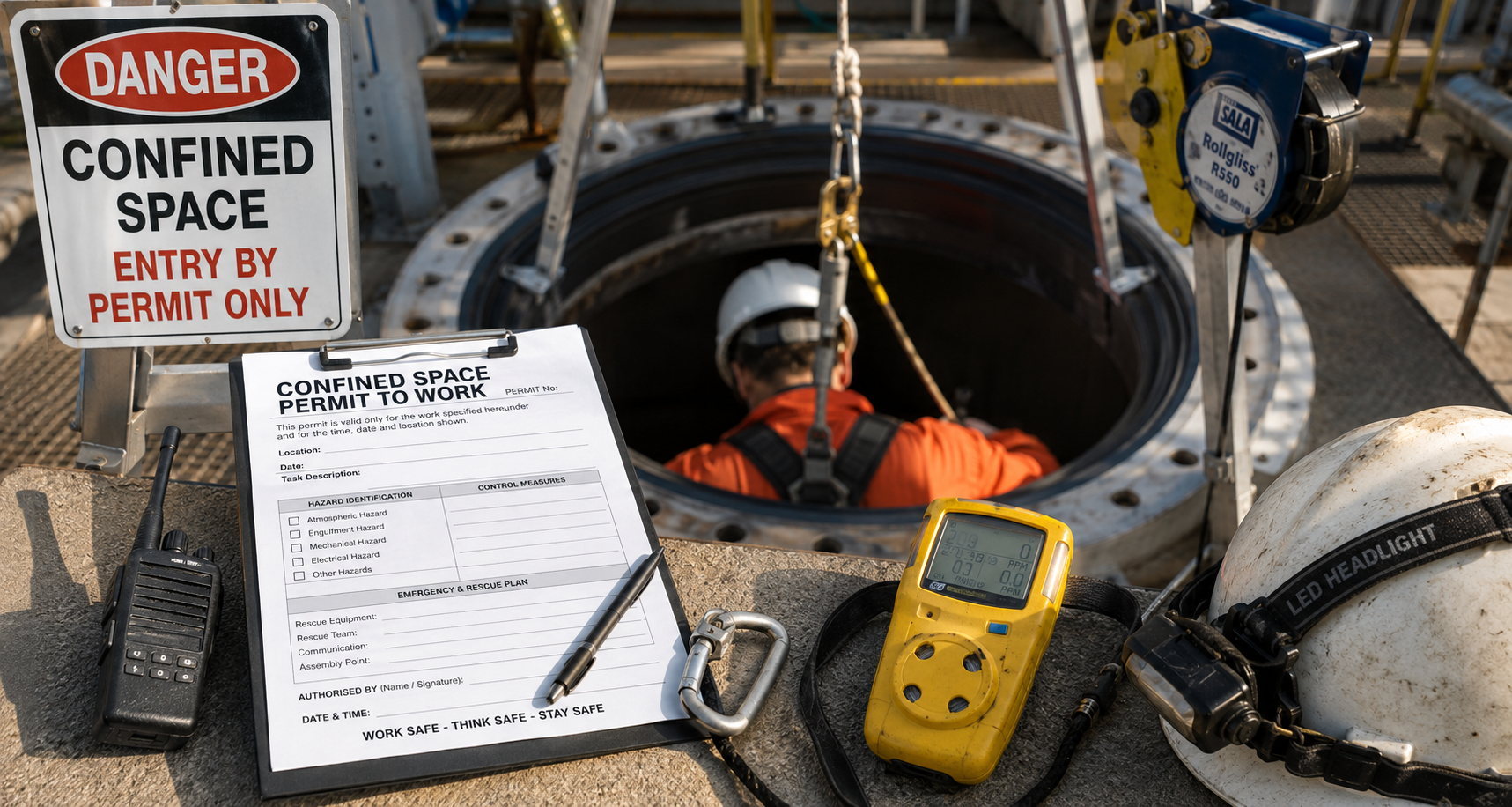
(1) No person at work shall enter or carry out work in a confined space unless there have been prepared in respect of that confined space suitable and sufficient arrangements for the rescue of persons in the event of an emergency, whether or not arising out of a specified risk;
(2) The arrangements referred to in that paragraph shall not be suitable and sufficient unless;
a) they reduce, so far as is reasonably practicable, the risks to the health and safety of any person required to put the arrangements for rescue into operation; and
b) they require, where the need for resuscitation of any person is a likely consequence of a relevant specified risk, the provision and maintenance of such equipment as is necessary to enable resuscitation procedures to be carried out
(3) Whenever there arise any circumstances to which the arrangements referred to in paragraph (1) above relate, those arrangements, or the relevant part or parts of those arrangements, shall immediately be put into operation
The following rescue arrangements would be classed as suitable and acceptable methods;
I. Self-Recovery.
If an entry needs to be made then this is the standard that we should be aiming for.
Low or medium risk confined spaces where entrants can self rescue.
Likelihood of specified risks have been considerably reduced or removed. All risks have been reduced by various control measures as far as reasonably practicable.
II. Assisted Recovery/Non-Entry Rescue.
This is when an entrant/casualty is extricated from the space by a mechanical aid such as a winch. Likewise, another team member could assist in getting the entrant who is in difficulties to the egress point or to the winch, this is also known as a ‘snatch rescue’.
If snatch rescue forms part of the rescue plan, then the Risk Assessment, Method Statement (RAMS) will need to clearly highlight what is to be expected of the entrants if such a rescue was required to be effected.
At the time of an incident a Dynamic Risk Assessment (DRA) would be carried out, to ensure that a snatch rescue could be carried out safely and that no other entrant’s safety was jeopardised. For example, entrants wearing Escape Breathing Apparatus (EBA), would they have enough air to safely perform a snatch rescue…….. Possibly not! Or is it a medical emergency where EBA isn’t an isssue.
III. Standby Rescue Team.
The rescue team will consist of a minimum of three, rescue qualified personnel.
The rescue team will only be deployed when the entrants are unable to self-recover.
Deployment will usually be due to:
- An incident within an NC4 classified Confined Space – Non standard entry. The risk assessment would be determined based on the type of confined space being entered and other factors, such as oxygen deficient, toxic atmosphere etc.
- The location of nearest emergency services. A confined space job working in a remotely, self-recovery may be adequate with other risks reduced due to control measures, but if an incident occurred, then the emergency services may be delayed considerably. For the record, this would not be classed as relying on the emergency services as the confined space would have been suitably risk assessed and self-recovery would be deemed as suitable the rescue team would be classed as an added control measure.
- Some companies require standby rescue teams on all confined space jobs, this may not be a requirement through the classification of the confined space but may be down to the companies’ policies and procedures.